
There is nothing like waking up to warm cinnamon rolls right out of the oven! These sourdough cinnamon rolls made with fresh milled flour are a sweet delicious treat that you can feel confident serving to your family!

- Why You will love these Sourdough Cinnamon Rolls!
- Ingredients and Substitutions for Sourdough Cinnamon Rolls
- How to Make Sourdough Cinnamon Rolls with Fresh Milled Flour
- Tips for Making Sourdough Cinnamon Rolls
- Frequently Asked Questions
- How to Store Leftovers
- Sourdough Cinnamon Rolls Made with Fresh Milled Flour
- When do you make Cinnamon Rolls?
- Other Articles You May Enjoy
- Pin For Later
Why You will love these Sourdough Cinnamon Rolls!
Irresistibly Delicious – These cinnamon rolls are soft, fluffy, sweet and absolutely irresistible right out of the oven! Whenever I make a batch they are gone quick. I love to eat them with my 3 ingredient cream cheese icing.
Made with Sourdough and Fresh Milled Flour – While no cinnamon roll is healthy, these cinnamon rolls are as close as I can get! The dough is fermented and with all the nutrients from the fresh milled flour they are a delicious treat and keep you filled longer than a normal cinnamon roll.
Soft and Chewy – These cinnamon rolls are soft and chewy just like cinnamon rolls should be. Sometimes with fresh milled flour recipes the dough is dense, but these cinnamon rolls are fluffy and delicious!

Ingredients and Substitutions for Sourdough Cinnamon Rolls
Dry Ingredients
Fresh Milled Flour – I use a Komo Mill to grind the wheat berries into flour. I love half hard red and half spelt for this dough, but have been experimenting with khorasan instead of spelt lately too. You could use hard white instead of hard red if you want to have a dough that tastes more like a store bought bread.
Sugar – I use organic cane sugar in this recipe. You could substitute sucanat, date sugar, or coconut sugar as a one to one replacement.
Salt – Any salt you have will work, but remember that some whole salts like Redmond’s Real Salt and Celtic Salt can leave a gritty texture in your bread because of the extra minerals they have.
Cinnamon – I use cassia cinnamon, but ceylon cinnamon would work fine too. If you want to leave out or add more cinnamon you are welcome to!
Nutmeg – I love adding nutmeg to recipes that ask for cinnamon. I think the flavors go well together. Feel free to leave the nutmeg out if you like.
Wet Ingredients
Molasses – I use this molasses to make the brown sugar for the filling. If you are using store bought brown sugar leave it out.
Milk – If you want to replace the milk with water, whey or an alternative milk, that will work well!
Sourdough Starter – I prefer a sourdough starter with a dough like consistency. If you have a runny sourdough starter you may need more flour to balance it out.
Oil – I use olive oil, but any oil you prefer will work. If you choose to use coconut oil or butter, melt it first. As your rolls cool, know that the coconut oil and butter will set up again in the bread and it will make the bread stiffer. Serving your bread warm will solve that problem though.
Vanilla Extract – I make my own vanilla extract. Store bought will work fine as well.
Butter – The butter has to be room temperature, but not melted. If it is a cold day, you can heat the butter in the microwave for 5-10 seconds at a time to get it to a spreadable consistency!
How to Make Sourdough Cinnamon Rolls with Fresh Milled Flour
Mixing the Dough Together
Mill the Flour. Use your mill to grind the flour.
Mix together all the dry ingredients. Mix the flour, cinnamon, nutmeg, salt and sugar together in a medium size bowl.
Combine all the wet ingredients together. Mix the vanilla, oil, starter and milk together in the flour well.
Combine the dry and wet together. Make a well in the dry ingredients and add the wet ingredients to the well. The dough will look like a sloppy mess right now.
Rest for 30 minutes for the flour to hydrate. Fresh milled flour needs extra time to soak up water.
Start the ‘stretch and folds’ or knead the dough. Knead the dough for 5-10 minutes or until it can pass the window pane test. If you want to do stretch and folds then plan to do 4-6 of them.
How to Stretch and Fold
If stretch and folds is a new term for you, I want to assure you that stretch and folds are easy and can change your baking life!
Stretch and folds are a great alternative to kneading bread dough. I preform about 3-6 sets of stretch and folds for each dough I make. By the end of the stretch and folds, my dough is holding together, feels smooth, and breaks only after stretching pretty thin.

To do a stretch and fold means to take a side of the dough and stretch it as high as your bread will allow. Then fold that piece over the rest of the ball of dough. This is easiest if your hand is wet.
Rotate the bowl 90 degrees and do another stretch up as high as the bread will allow. Then fold that piece over the ball of dough and rotate another 90 degrees.
Stretch and fold side 3 and side 4, then place the dough fold side down so that it looks nice.
This whole series of movements is only ONE set of stretch and folds. By the end of one set of stretch and folds your bread doesn’t really want to stretch anymore and the gluten needs time to relax.
After waiting at least 15-30 minutes do another set of stretch and folds. I do about 3-6 sets of stretch and folds for each bread I create.
How do I know I am Done with Stretch and Folds?
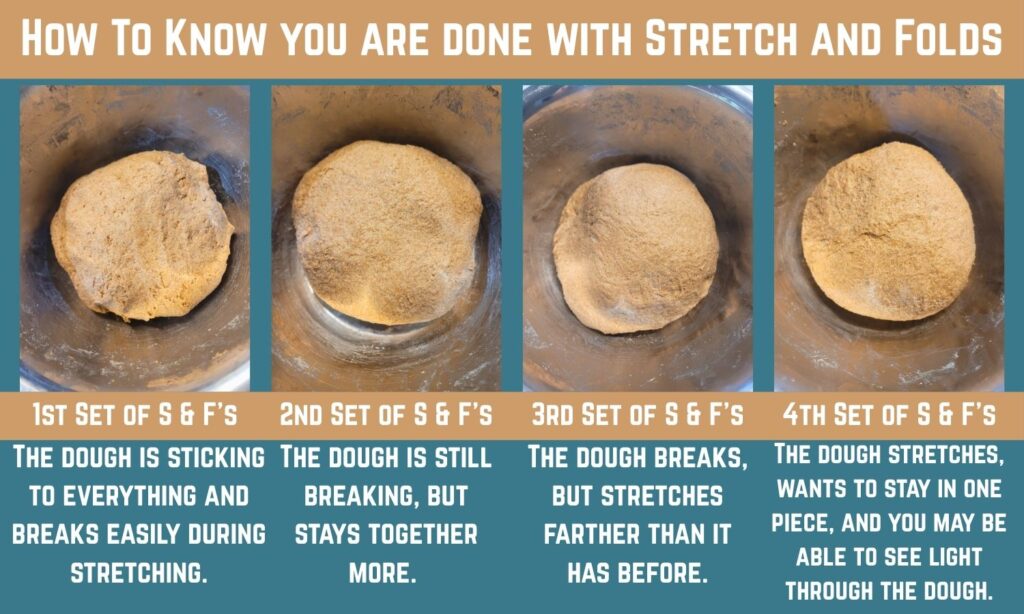
You will know that you are done with the stretch and folds when your dough feels like it is smooth, which means that it doesn’t break apart until it is stretched far or thin.
The dough will stick to you a little bit, but almost all of it will stay with the ball of dough. Your hands should get easier and easier to clean as you finish your sets of stretch and folds.
The more sets of stretch and folds you complete, the more gluten you are developing and that will help your dough rise and bake beautifully!
Let the dough bulk ferment. Bulk ferment means the bulk (most) of the time that the dough will ferment.

Shaping the Sourdough Cinnamon Roll Dough and Adding Fillings
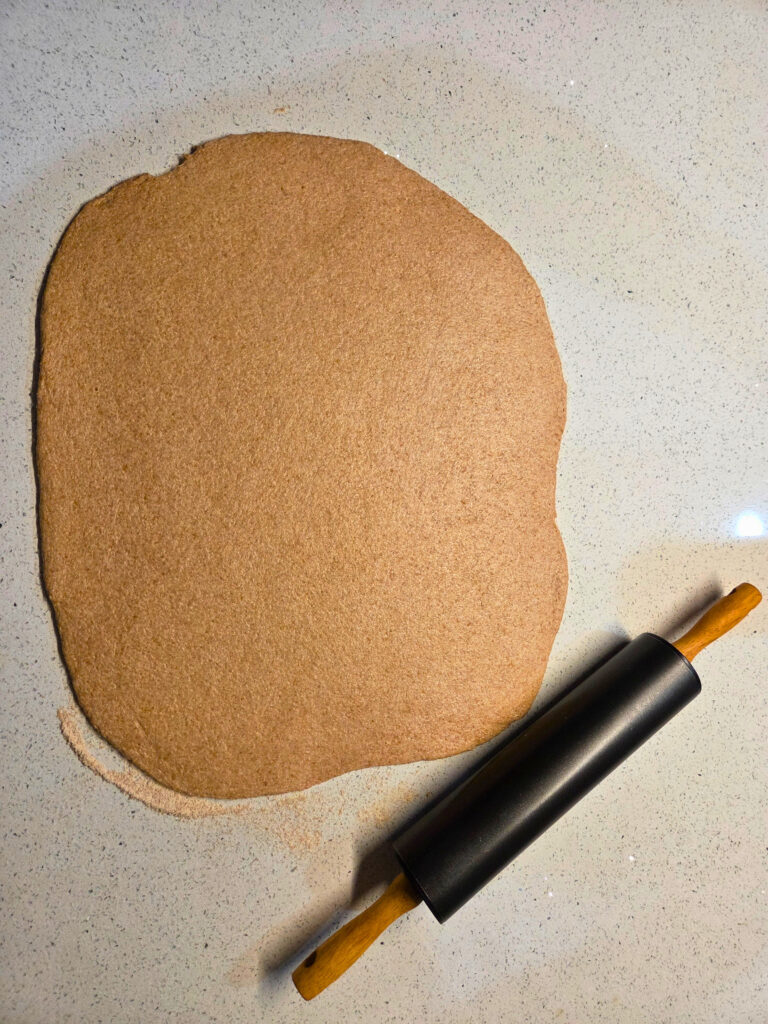
Turn your dough out on a floured or oiled surface. You do not want the dough to stick to the counter at all!
Roll to about half an inch thick (about 1 cm) in a rectangular shape. Don’t stress about making the rectangle perfect, just get pretty close!
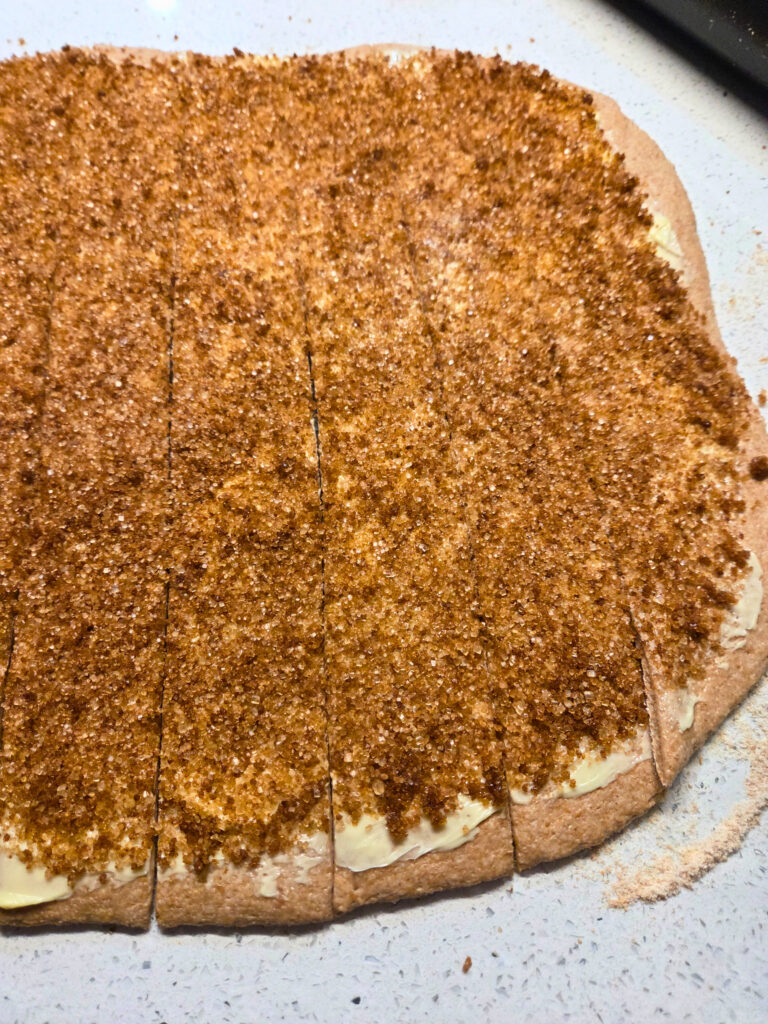
Spread with butter and then spread the cinnamon sugar mixture all over the top. I like to cover the entire dough without leaving any border, because I don’t mind if the rolls unravel a little.
If you want them to stay together, then leave one half an inch (1 cm) of edge bare to stick the cinnamon roll dough together.
Shaping The Sourdough Cinnamon Rolls
Cut 1.5 inch long strips (4-5 cm). Once your cinnamon rolls are covered in butter and cinnamon sugar cut them with a pizza cutter.
Use the pizza cutter to cut 1.5 in strips from the long edge to the long edge. You want the shorter side to be the length of the cinnamon roll.

Roll the cinnamon rolls up. Take the edge and roll it up. If you notice that the dough is loose, then pull the roll back toward yourself to create more tension.

Place in a greased 9×13 inch pan for baking and repeat.

Cover and second rise. Once they are all in the pan, cover it and let them rest for a second rise. They will fill out the pan and when you gently shake the pan they will jiggle a little.
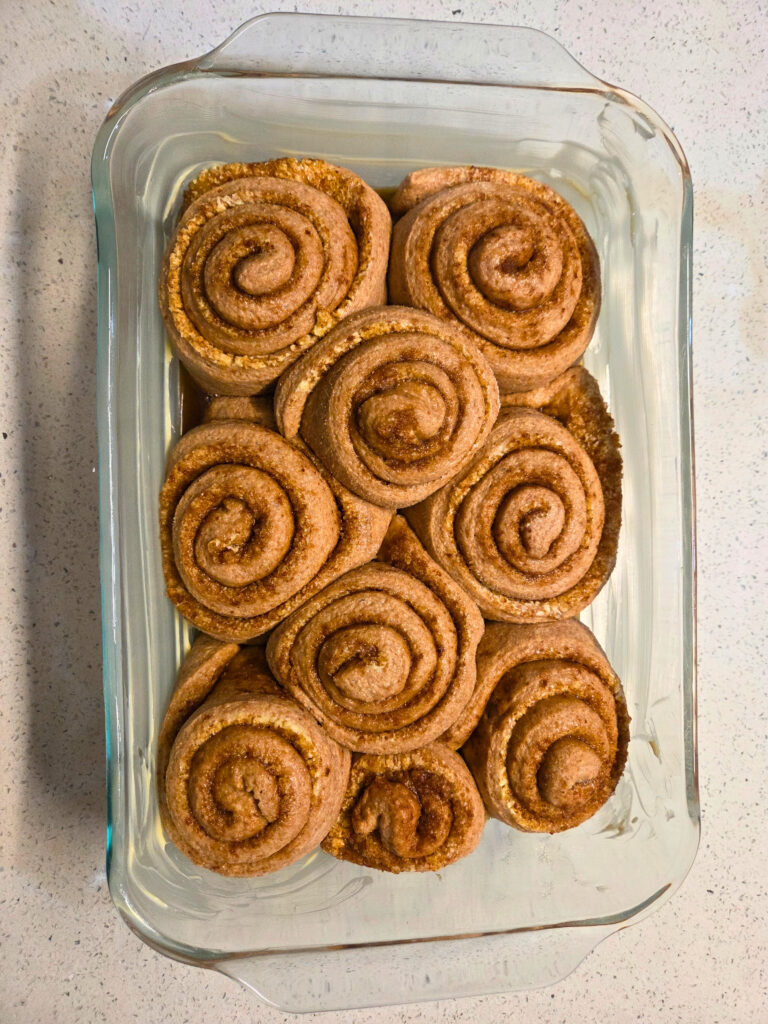
Bake at 350 degrees Fahrenheit (165 Celsius) for 45-60 minutes.
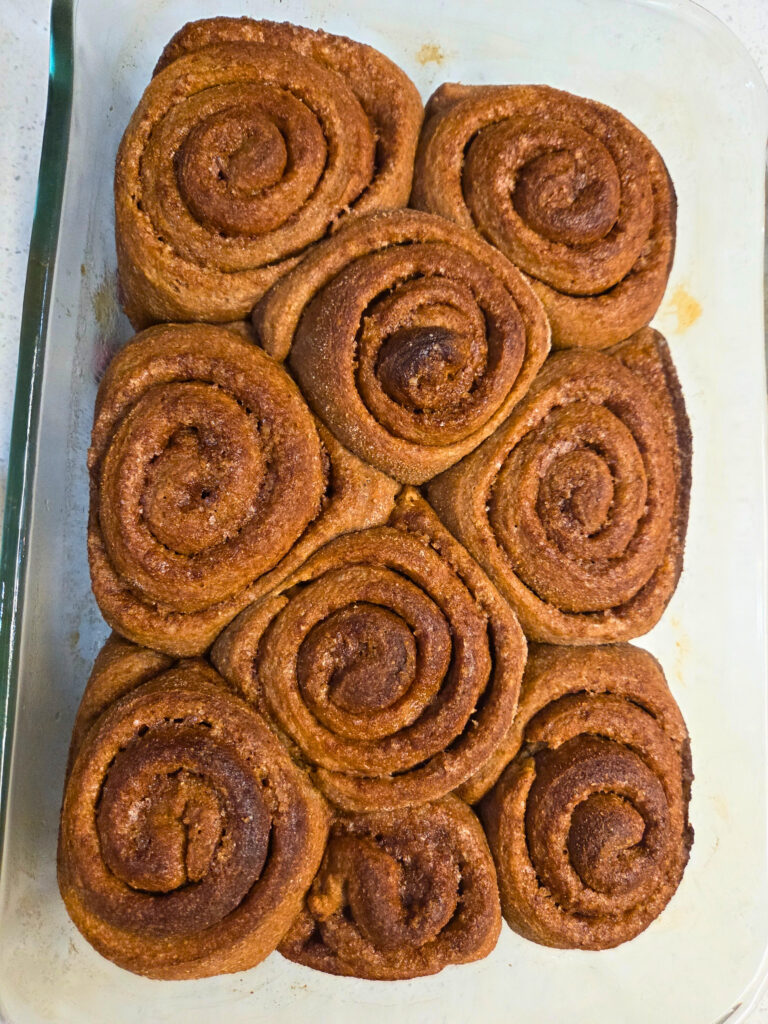
Cool for 15 minutes and serve!
Tips for Making Sourdough Cinnamon Rolls
Use a Pizza Cutter. I used to roll the whole log up and then cut the rolls apart, but using a pizza cutter to cut the flat dough surface works better!
The rolls look better and they don’t have big gaps between layers. I really think that pizza cutters are the way to go!
Don’t let the dough go limp. When you notice the dough go limp or floppy, you can lift and pull the roll to stretch it out more. That will create more tension and tension is what makes the rolls beautiful!
Frequently Asked Questions
Can I Reheat these Cinnamon Rolls?
Yes! When I serve them to my family after they are cool, I put them in the microwave for 30 seconds to heat them back up.
To heat them in the oven, set it to 325 degrees Fahrenheit (165 C) for 5-10 minutes depending on how many you are reheating.
Can I Freeze these Cinnamon Rolls?
Yes! I like to freeze them right after they are rolled. When I am ready, I set them out overnight to thaw and finish rising.
In the winter, I set them out on the counter all night. In the summer, I start them on the counter while I make dinner and then move them to the fridge overnight.
Can I add Nuts?
Yes! If you want nuts, sprinkle half a cup of your favorite nuts on after the cinnamon and sugar mix. Then roll them up and continue with the directions!
How to Store Leftovers
Store the cinnamon rolls in an airtight container on the counter for 2-3 days. Then you can store them in the fridge for 4 days more.

Sourdough Cinnamon Rolls Made with Fresh Milled Flour
Equipment
- 1 Large Mixing Bowl
- 1 Small Mixing Bowl
- 1 Mixing Spoon
- 1 Set of Measuring Spoons
- 1 Kitchen Scale
- 1 Pizza Cutter
- 1 9×13 in Pan
Ingredients
Dough Ingredients
- 500 Grams Fresh Milled Flour I use 400g Hard Red and 100g Spelt or Khorasan
- 60 Grams Sugar
- 10 Grams Salt
- 1 Tablespoon Cinnamon optional
- ½ teaspoon Nutmeg optional
- 280 -300 Grams Milk or Water
- 30 Grams Oil
- 1 teaspoon Vanilla Extract
- 180 Grams Sourdough Starter active
Filling Ingredients
- ½ Cup Butter 1 stick, room temperature
- 1 Cup Brown Sugar light or dark
- 1 Tablespoon Cinnamon
- ½ Cup Nuts optional
Instructions
Mixing the Dough Instructions
- Mix the flour, sugar, salt, cinnamon, and nutmeg dough ingredients together in a bowl. Then make a well or hole in the middle of the flour that the wet ingredients will be poured into.
- Add the milk to the well in your flour first; then add the oil, vanilla, and starter. This prevents the oil from mixing with the dough first, creating oily flour clumps.
- Mix until combined and no dry pockets of flour remain. Let sit for 30 minutes.
Stretch and Fold Instructions
- You can choose to knead your dough for 5-10 minutes right now.
- I prefer to preform sets of stretch and folds with a wet hand.
- Stretch and folds are where you take a piece of the dough in our hand and stretch it up and then fold it over the top of the dough. Turn the dough 90 degrees and then stretch the dough up and fold it over the top again. Turn 90 degrees again and stretch and fold again. Do it once more to the final side of the bowl.
- Let the dough rest for 15-20 minutes. Then preform another set of stretch and folds with a wet hand.
- Let the dough rest for 15-20 minutes. Then preform another set of stretch and folds with a wet hand.
- You may do another set of stretch and folds if you feel like your bread dough is still not ready. You are looking for the dough to be smooth like it wants to stick to itself more than it sticks to you.
- Once you are happy with how the dough looks and feels cover the bowl with a damp towel, shower cap, or plastic wrap.
Bulk Ferment
- Set your dough into a warm space for 5-7 hours.
- Check the bread after 5 hours in the warm environment. Has it grown in size? If you shake the bowl gently does it wiggle at all? Yes to both means on to getting the insides ready!
- If the answer is no to either, then let the dough sit for another 30 minutes to an hour and check again.
Getting the Insides Ready
- While your dough is fermenting in that warm spot lets get the insides ready!
- In a small bowl; mix together the brown sugar and cinnamon together. Cover and set aside.
- Make sure the butter is room temperature and if you want nuts they are set aside.
Shaping
- Before you start shaping, butter a 9×13 pan.
- Dust your work surface with flour or coat in oil. Once your bread has bulk fermented turn it upside down onto your work space.
- Roll your dough until it is about ½ an inch thick (1 cm). Try to roll the edges so that your dough is a rectangular shape.

- Once your dough is rectangular then you can cover it in a layer of butter. Then sprinkle your brown sugar mix all over it. Try to make it as even as you can.

- Get your pizza cutter or knife and slice the dough in 1½ inch slices all down the long side of the dough.

- Take one edge and begin rolling it up. If it is too loose then pull the roll towards yourself to stretch it and create tension.

- If your dough is sticking to your work surface use a bench scraper to help you lift it without stretching it too far.

- Place the rolls into a buttered 9×13 in pan. Let it rise about 2-3 hours. Test if it is ready to bake by gently shaking the pan to see if the rolls jiggle too. That means there is air inside!

- Bake at 350℉ for 45-60 minutes. It is done when you stick a thermometer in the middle of a center roll and it measures 195-205℉.

- Let cool for about 15 minutes then serve!

Notes
When do you make Cinnamon Rolls?
Let us know in the comments down below if you have any special cinnamon roll traditions!
Other Articles You May Enjoy
Simple Cream Cheese Icing with NO Refined Sugars
Delicious Fresh Milled Sourdough Cinnamon Raisin Swirl Bread
The Simple Way to Care for a Sourdough Starter
Pin For Later

Leave a Reply